
How our technology-enabled, multidisciplinary rehabilitation meets the new NICE standard
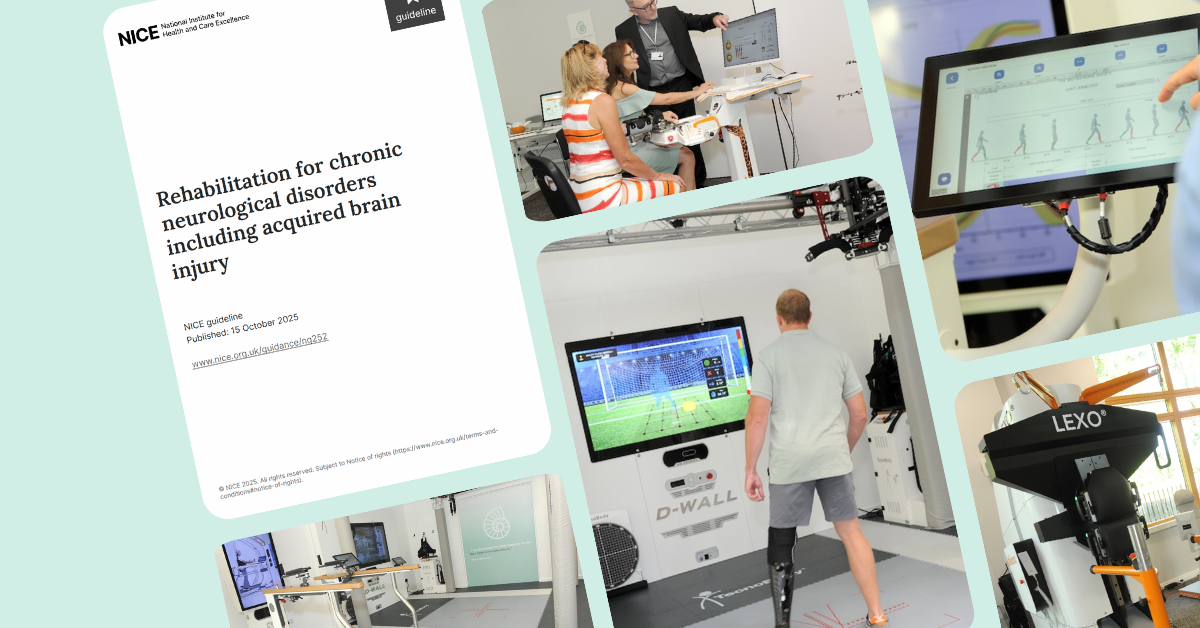
The publication of NICE Guideline NG252, Rehabilitation for Chronic Neurological Disorders Including Acquired Brain Injury (October 2025), sets a new benchmark for how neurological rehabilitation should be delivered in England. Its focus on multidisciplinary teamwork, measurable outcomes, integration across hospital and community settings, and the use of digital and assistive technology aligns directly with the model already established at Resilience Neuro Specialists.
Our approach, combining evidence-based practice, advanced technology and coordinated community delivery, responds in full to the key recommendations. We are now seeking to work in partnership with NHS commissioners, discharge teams, and healthcare providers across Birmingham and the wider Midlands to expand access, share expertise, and deliver consistent, high-quality community neurorehabilitation that supports recovery, independence, and overall wellbeing.
The NICE guideline recognises what many clinicians and commissioners already understand. Across England, community neuro rehabilitation is inconsistent and under-resourced. Fragmented services, variable quality, and long waits after discharge limit recovery and increase costs for the health system. In the Midlands, where demand is high, these challenges are particularly visible.
What the new NICE guideline requires
The NICE rehabilitation guidelines call for rehabilitation to be delivered through multidisciplinary teams including physiotherapy, occupational therapy, speech and language therapy, neuropsychology and rehabilitation assistants. It states that rehabilitation should be holistic, covering physical, cognitive, communication, and emotional needs. Plans must be personalised, reviewed regularly, and coordinated through a single point of contact or key worker.
The guideline also highlights the need for integrated service design. Rehabilitation should link hospital, home, community, and voluntary-sector settings, enabling continuity and timely re-access. NICE advises that services include options for telehealth or remote therapy to improve outcomes and reduce barriers to participation.
When describing interventions, NICE recommends task-based interventions, treadmill or robot-assisted gait training where available, neuromuscular and functional electrical stimulation, balance and sensorimotor exercises, and the use of gaming or virtual-reality approaches to enhance engagement. These technologies should be delivered by trained therapists as part of a structured programme rather than as standalone treatments.
A model aligned with national standards
Resilience Neuro Specialists, based in the Midlands, provides exactly this type of integrated, multidisciplinary service. Our team consists of specialist neuro physiotherapists, occupational therapists, neuro dietitians, speech and language therapists, a rehabilitation coach, neuropsychiatrists and clinical psychologists within coordinated programmes designed around each individual’s goals. Therapy sessions are delivered in the community, at home, and within the Resilience Therapy Centre in Warwickshire, which offers access to advanced rehabilitation technology consistent with NICE-listed interventions such as robotic gait training and functional electrical stimulation.
“These new guidelines could have been written around the Resilience approach,” says Clinical Director Michelle Kudhail, a neurological physiotherapist with more than 30 years of experience. “NICE defines rehabilitation as a coordinated, ongoing process that addresses the whole person, not just their physical impairments. That’s exactly what we do. Every individual receives a holistic assessment, structured therapy sessions across all disciplines and access to advanced technology so people can achieve positive outcomes.”
Integration and continuity
NICE emphasises the need for smooth transitions between acute and community rehabilitation. Every person leaving hospital should have an identified rehabilitation contact, a written plan, and timely access to ongoing therapy. Resilience Neuro Specialist’s service design mirrors this expectation. Our team works directly with discharge planners, case managers, and community clinicians to ensure people do not lose momentum after inpatient treatment.
Individuals can be referred to Resilience Neuro Specialists by NHS teams, insurers, or privately, and can self-refer for assessment. Each programme includes clear neuro rehabilitation objectives agreed between the client, their family, and the therapy team, followed by regular outcome reviews and progress reports. This process reflects NICE’s call for measurable, person-centred goals and shared decision-making.
Technology supporting clinical delivery
In line with the NICE neurological rehabilitation guideline, technology at the Resilience Therapy Centre is used to support – not replace – expert therapy. Equipment such as the Lexo robotic gait trainer, Walker View gait and motion analysis system, D-Wall Elite 3D movement platform, and Fesia Grasp functional electrical stimulation enable therapists to deliver repetitive, data-rich, and task-oriented training to optimise independence.
Alongside advanced equipment, every programme includes targeted training designed to rebuild practical skills and confidence for real life activities such as walking, reaching, and personal care.
Within our neurorehabilitation centre and at home, these systems provide objective measures of movement, balance, and coordination, helping to track improvement over time and inform care planning.
NICE notes that the integration of digital or remote approaches can extend access to therapy. Resilience applies this through supervised home-based exercise programmes and virtual follow-up sessions, allowing people to continue practising between appointments while therapists monitor progress remotely.
Person-centred practice in action
Evan*, a 25-year-old who sustained a brain injury in a road traffic collision, began therapy with Resilience Neuro Specialists after hospital discharge. His multidisciplinary programme combined physiotherapy, occupational therapy, and neuropsychology with robot-assisted gait training and electrical stimulation. Goals were set collaboratively to rebuild mobility and confidence. Over three months of dedicated brain injury rehabilitation, Evan progressed from dependent transfers to walking independently. His progress was measured using balance and coordination data captured during therapy, meeting NICE’s emphasis on objective outcome monitoring and regular review.
“Seeing his data and physical improvement side by side made a real difference,” says Suzi Kerrell-Vaughan, Occupational Therapist and Clinical Lead. “It supported his motivation and gave clear evidence of recovery for his wider care team.”
Education is central to our approach. Clients and families learn how to manage challenges such as fatigue and pain through self-management techniques, home exercise, and lifestyle adaptation.
Commissioning implications
For commissioners, NG252 outlines the essential features of effective rehab services. These include a single point of contact, multidisciplinary coordination, agreed timing and frequency of sessions, integration with other services, and access to both face-to-face and remote delivery. The guideline encourages Integrated Care Boards to ensure equitable access, clear referral criteria, and service specifications that define expected outcomes and review mechanisms.
Resilience Neuro Specialists’ model already meets these requirements. Our regional reach across Birmingham and the West Midlands expands community capacity while maintaining quality and governance. Structured reporting and outcome data provide transparency for commissioners and funders, aligning with NICE’s requirement for routine monitoring and service evaluation within neurological rehabilitation services.
Building capacity across the Midlands
The shortage of community neurological rehabilitation services has long been recognised. The NICE brain injury rehabilitation guideline provides a framework to address it. By combining evidence-based practice, advanced technology, and multidisciplinary expertise, Resilience Neuro Specialists is contributing to the expansion of community neuro rehabilitation in Birmingham and the West Midlands.
By combining specialist education, evidence-based therapy, and innovative technology, Resilience Neuro Specialists helps people move beyond injury to rebuild function, independence, and quality of life. Our goal is to ensure that people recovering from neurological injury or illness can experience high-quality, measurable, specialist rehabilitation close to home.
Working together with neurorehabilitation commissioners
Looking for a West Midlands rehabilitation centre for outpatient support? If you’re living with a long-term neurological condition such as multiple sclerosis, coping with symptoms following a stroke, or recovering from a brain injury, or you’re a professional supporting someone who wants to improve mobility, restore function in activities of daily living, and return to live independently, get in touch with Resilience Neuro Specialists to arrange an initial assessment and start a personalised rehabilitation programme. We support medically stable people aged from 16 years up.
Resilience Neuro Specialists welcomes partnership with NHS commissioners, hospital discharge teams, and health and care organisations across the West Midlands, Birmingham, Coventry, Warwickshire, Worcestershire, Staffordshire and beyond.
Our approach is fully aligned with the new NICE rehabilitation guidelines, and provides a ready model for integrated, outcome-monitored, and accessible rehabilitation.
To discuss partnership or referral opportunities, contact us or Alastair White, Business Development Director
📧 alastair@resilienceneurorehab.co.uk
📞 07766 666015
*Patient details anonymised.
Share your thoughts